Who lives where and why? Im/migration patterns and policies
Today we are going to connect themes from the sociology of im/migration with those we have already learned (and discussed) from urban and community sociology.
As we do this, don’t forget this point emphasized in our last class:
one of the most important ideas to take away from urban and community sociology is that the growth patterns and settlement characteristics we observe in cities are anything but natural; in fact, the are the result of political and economic decisions made by political officials, business leaders, and other stakeholders (including residents).
The push and pull factors of migration
The twin concepts of push and pull factors are used by migration scholars to explain both why people leave their homes and why they go to the places they do.
By push factors we are referring to the aspects of life in the home country or community that drive people to leave, to seek out better options elsewhere. In the context of the Great Migration in the United States, our textbook suggests that these push factors included “incredible injustices” and a great number of “humiliations and blocked opportunities.”
Pull factors refer to the social, cultural, and economic forces that draw people to new countries and communities. Again, in the context of the Great Migration, these included the strong pull of job opportunities in the factories of Northern cities, but also the promise of a vibrant cultural life in the black metropolis
The classic model of human ecology
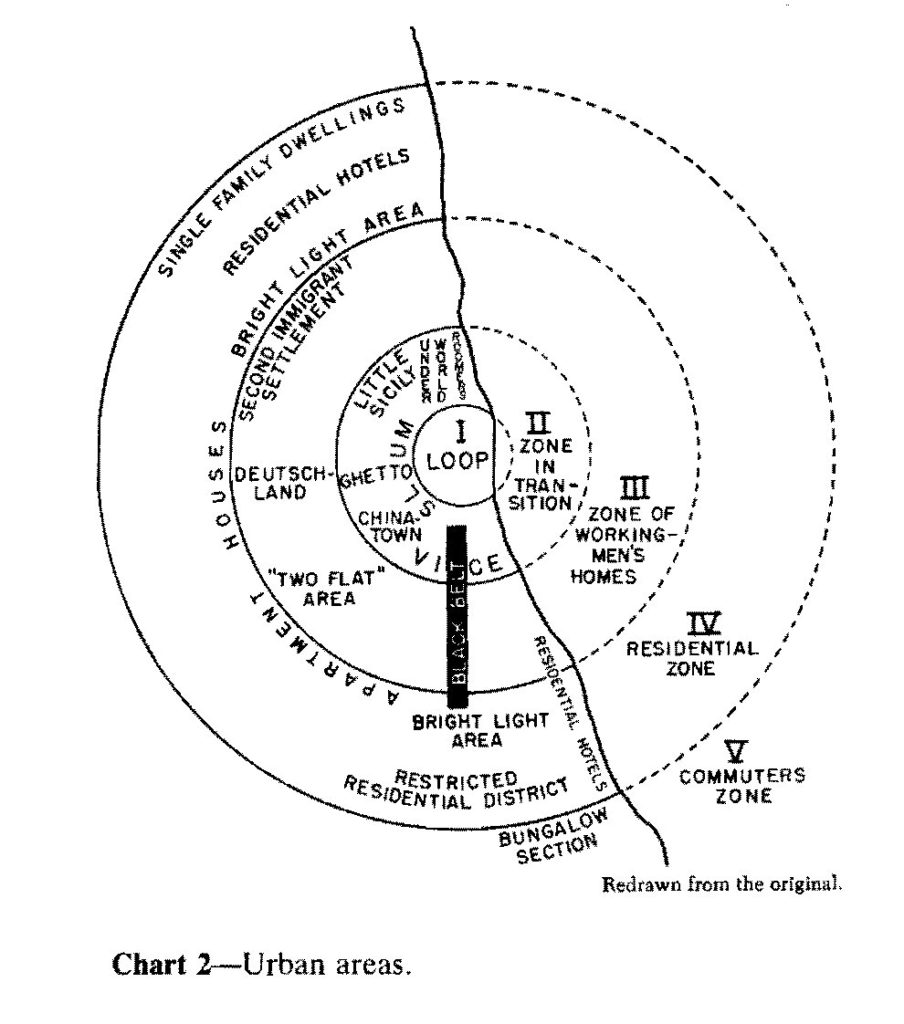
Ernest Burgess of the Chicago School of Sociology generated a highly-influential model of immigration and residential patterns in the city. That model is generally referred to as a human ecology model.
The model’s basic assumption is that “the city filters groups of people into the environment that provides the best ‘fit’.”
The “new” and “old” immigration
Take a moment to think about each of the following questions related to the new and old immigration:
- What do we mean by the “new” (post-1965) immigration to the United States?
- How is this different from the “old” immigration?
- Can you identify the cause in this changing profile of immigration?
After you’ve spent a few moments thinking about these questions (and what you learned from our textbook), then pair up with your closest neighbor and share your answers to these questions.
Contemporary immigration policy
The next topic we’ll deal with is immigration policy and its recurring failure(s). For this, break up into small groups to consider the following questions. Be prepared to share with the rest of the class what you come up with!
- What is the logic of the increasingly harsh immigration control policies applied in the United States? That is, why do policymakers think these will be effective?
- How can we explain the recurring failure of these policies?
- Do you have any thoughts about what might be a better approach to immigration policy in the United States and other immigrant-receiving countries?
Immigrant integration
Finally, let’s talk about the issue of immigrant integration and residential patterns.
- What do we know about where immigrants live?
- Have their residential patterns changed from what they were like when Ernest Burgess developed his human ecology model?
- What is the connection between immigration and what the textbook describes as “global neighborhoods”?
- Are there differences in settlement patterns among different immigrant groups?
- If so, what other factors (besides national origin itself) can help explain these differences?